
What happens when someone tries to kill another person but fails? Does the law simply ignore it? Absolutely not. India’s criminal law punishes the attempt just as seriously as the act itself. Understanding Section 109 Attempt to Murder of the Bharatiya Nyaya Sanhita (BNS): Explained is exactly what this article sets out to do. This provision replaced the old Section 307 of the Indian Penal Code (IPC) and comes with serious legal consequences.
You don’t need to actually kill someone to face a murder-related charge in India. If you tried to kill someone and the circumstances clearly show that you’re already in legal trouble. Section 109 BNS covers the intention, the act, and the punishment that follows. This article breaks it all down in simple, clear terms. Let’s get into it.
Related Post: Understanding Section 109 Attempt to Murder of the Bharatiya Nyaya Sanhita (BNS): Explained
Explanation of Section 109 Attempt to Murder BNS
Section 109 of the BNS 2023 states that if a person performs any act with the intention or knowledge that had that act caused death they would be guilty of murder, then they are liable for punishment under this section. In simpler terms, it’s not about whether the victim actually dies. It’s about what the accused intended and what could have happened.
The section prescribes imprisonment up to ten years and a fine where no injury is caused. However, if the attempt causes hurt to any person, the punishment escalates significantly the offender can face life imprisonment. Subsection (2) goes even further: if the accused is already serving a life sentence and causes hurt during an attempt to murder, the court can impose the death penalty or life imprisonment for the remainder of their natural life.
Ingredients of Section 109 Attempt to Murder BNS
For a court to convict someone under Section 109 Attempt to Murder, the prosecution must establish the following core ingredients:
- Intention or Knowledge: The accused must have intended to cause death or must have known that their act was likely to result in death. This is the most critical element without it, the charge doesn’t hold.
- An Overt Act: There must be a concrete, physical act taken toward committing the murder. Mere thoughts or even planning doesn’t qualify the accused must have done something.
- Murder-Level Circumstances: The act must be of such a nature that had death resulted, the accused would have been guilty of murder not culpable homicide or any lesser offence.
- Hurt Caused (Aggravated Form): If injury is caused during the attempt, the punishment automatically increases to life imprisonment.
- Life Convict Provision: Special treatment is given to those already under life imprisonment, with the possibility of capital punishment if hurt is caused.
Punishment for Section 109 Attempt to Murder
| Scenario | Punishment |
| Attempt with no injury | Up to 10 years imprisonment + fine |
| Attempt with hurt caused | Life imprisonment or up to 10 years + fine |
| Life convict + hurt caused | Death penalty or life imprisonment (natural life) |
Key Elements That Constitute Attempt to Murder Under Section 109 BNS
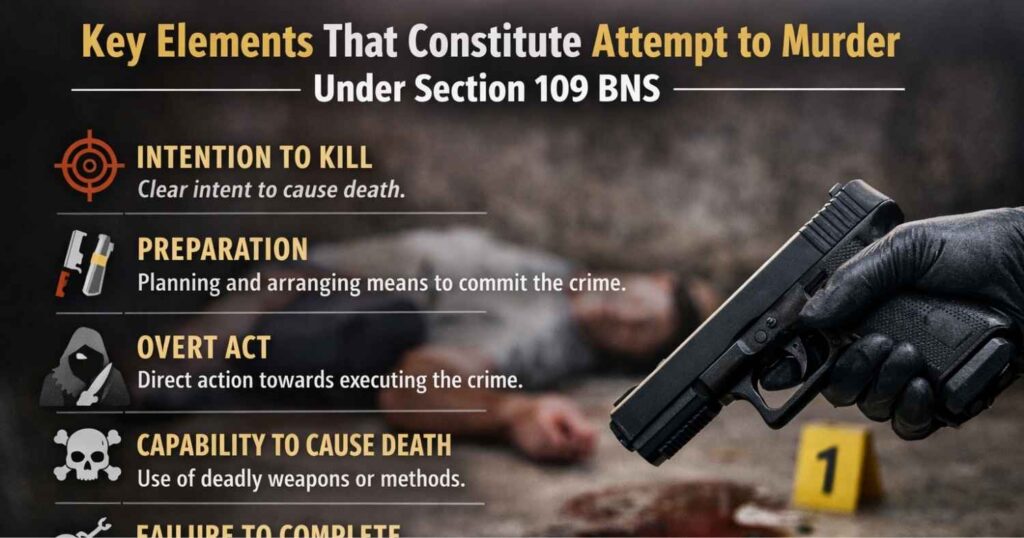
The legal meaning of attempt to murder goes beyond just pulling a trigger or swinging a weapon. Courts in India look at the totality of circumstances the accused’s state of mind, the nature of the act, and what was likely to result. The key question is always: if the victim had died, would this have been murder?
It’s also worth understanding that the law distinguishes between intention and knowledge. A person who fires a gun at someone’s chest clearly intends to kill. But even someone who acts with knowledge say, serving food they know is poisoned can be held liable even without direct murderous intent. Criminal liability for attempts in India, therefore, covers both deliberate and reckless conduct that falls within the murder threshold.
Punishment Framework for Attempt to Murder in the Bharatiya Nyaya Sanhita
The punishment framework under Section 109 BNS is tiered meaning it scales with the severity of the outcome. If no one gets hurt, the maximum sentence is ten years. That might sound lenient but consider this: the mere act of attempting to kill someone, even if it fails completely, still lands you in jail for up to a decade.
Where hurt is caused even minor injury the stakes rise dramatically. The court then has the discretion to impose life imprisonment, which the BNS explicitly defines as imprisonment for the remainder of the offender’s natural life. This clarification is one of the most significant changes from the old IPC. Repeat offenders already serving life sentences face the harshest end of the spectrum including the death penalty if they injure someone while attempting murder again. Clearly, the BNS doesn’t believe in second chances for the most dangerous offenders.
From Preparation to Attempt: When Does Liability Arise Under Section 109?
This is one of the most debated questions in criminal law when does preparation become attempt? The law draws a clear line here, and the illustrations within Section 109 itself help explain it.
Consider this: A buys a gun and loads it. That’s preparation no offence yet. But the moment A fires that gun at Z, it becomes an attempt to murder, regardless of whether Z is hit. Similarly, A mixing poison into food that’s still in their own possession is mere preparation. The moment A places that food on Z’s table, the attempt is complete. The principle is simple once the act moves from getting ready to actually doing, the law kicks in. Courts prove intention to murder by examining these precise moments and actions.
How Section 109 BNS Differs from the Former IPC Provision on Attempt to Murder
The difference between IPC 307 and BNS 109 isn’t dramatic but the changes are meaningful. Both provisions share the same core: you need intention or knowledge, an overt act, and murder-worthy circumstances. But the BNS has made two notable upgrades.
First, it explicitly defines life imprisonment as the remainder of the offender’s natural life. Under the IPC, this was often left to judicial interpretation, leading to inconsistency. Second, the BNS creates a specific provision for life convicts who attempt murder allowing courts to impose death or permanent imprisonment if hurt is caused. This directly addresses the gap where dangerous offenders behind bars had little additional legal deterrent against further violence. In both spirit and structure, Section 109 Attempt to Murder under BNS is more precise than its IPC predecessor.
Legal Interpretation and Court Approach to Attempt to Murder Cases in India
Indian courts have consistently held that proving intention is the backbone of any attempt to murder case. Judges look at factors like the weapon used, the body part targeted, the number of blows, and the surrounding circumstances. A single stab wound to the arm might not establish intent to kill but three stab wounds to the chest almost certainly will.
Courts also carefully distinguish attempt to murder from grievous hurt under Section 117 of the BNS. The dividing line is the accused’s state of mind, not just the physical outcome. This is why how courts prove intention to murder often involves examining witness testimony, medical reports, and the sequence of events. The accused’s conduct before, during, and after the act all come under scrutiny.
Illustrative Examples Section 109 Attempt to Murder BNS
The BNS itself provides four helpful illustrations:
- Illustration (a): A shoots at Z intending to kill him. Even if Z survives, A is guilty under Section 109.
- Illustration (b): A abandons a young child in a desert intending for it to die. Even if the child survives, A has committed the offence.
- Illustration (c): A loads a gun (preparation no offence). A then fires at Z (attempt offence complete). If Z is wounded, A faces life imprisonment.
- Illustration (d): A mixes poison into food still in their possession (preparation). A places it on Z’s table (attempt offence complete).
These examples make clear that the attempt to kill punishment kicks in the moment the accused moves from preparation to action.
Comparison of Section 109 Attempt to Murder BNS with IPC Section 307
| Aspect | IPC Section 307 | BNS Section 109 |
| Core principle | Same | Same |
| Definition of life imprisonment | Not explicitly defined | Explicitly = natural life |
| Special provision for life convicts | Not clearly outlined | Explicitly included |
| Punishment structure | Same tiers | Same tiers, with added clarity |
| Triable by | Court of Session | Court of Session |
Both sections are non-bailable, cognizable, and non-compoundable. The BNS simply brings more precision to areas the IPC left vague.
FAQs
What is Section 109 of BNS in simple terms?
It’s the law that punishes someone for trying to murder another person, even if the victim survives. Intention to kill is the key ingredient.
Is attempt to murder a bailable offence under BNS?
No. It’s a non-bailable, cognizable offence triable by the Court of Session.
Can attempt to murder lead to the death penalty?
Yes but only if the accused is already serving a life sentence and causes hurt during the attempt.
What’s the minimum sentence for attempt to murder without injury?
The law sets the maximum at 10 years but doesn’t fix a minimum. Courts exercise discretion based on the facts.
How is attempt to murder different from grievous hurt?
The key difference is intent. Attempt to murder requires proof that the accused intended or knew their act could cause death at the murder level not just serious injury.
Conclusion
Section 109 Attempt to Murder of the Bharatiya Nyaya Sanhita 2023 is a carefully constructed legal provision that holds offenders accountable even when their murderous act fails. It doesn’t matter that the victim survived what matters is what the accused intended and what could have happened. The BNS has strengthened this provision by clarifying life imprisonment, adding special penalties for life convicts, and drawing clearer lines between preparation and attempt.
Understanding this law matters not just for lawyers and law students, but for anyone who wants to know how India’s criminal justice system treats one of the most serious violent offences. If you or someone you know is ever involved in a case touching on this section, consulting a qualified criminal lawyer is always the right first step.

Daniel Cross is a legal researcher and freelance writer specializing in civil rights, policy analysis, and contemporary legal trends. With a strong background in academic writing and practical case review, he focuses on making complex legal concepts accessible to everyday readers while promoting clarity, fairness, and informed public discourse.