
When someone intentionally hits, injures, or harms another person, the law doesn’t look the other way. In India, Section 115 Voluntarily Causing Hurt of the Bharatiya Nyaya Sanhita (BNS), 2023 directly addresses such acts. It’s one of the foundational provisions in BNS criminal law clear, firm, and purposeful. Whether it’s a punch during a dispute or serving someone food you know will harm them, this section has something to say about it.
The BNS replaced the Indian Penal Code (IPC) in 2023, bringing updated language, stricter fines, and a more modern approach to criminal liability in India. Section 115 is a direct evolution of IPC Sections 321 and 323, and understanding it helps you know your rights and your responsibilities under Indian law.
Related Post: Section 318 Cheating of the Bharatiya Nyaya Sanhita (BNS)
Provision: BNS Section 115 Voluntarily Causing Hurt
Section 115 of the BNS lays out the law in two sub-sections. Sub-section (1) defines what “voluntarily causing hurt” actually means. It says: if a person does any act with the intention of causing hurt, or with the knowledge that the act is likely to cause hurt, and that act actually does cause hurt then they have voluntarily caused hurt. The focus here is on intent and knowledge, not just the outcome.
Sub-section (2) then prescribes punishment for this offence. Anyone who voluntarily causes hurt except in cases covered under Section 122(1) can face imprisonment up to one year, a fine up to ₹10,000, or both. Compared to the old IPC, the fine has gone up significantly, reflecting a tougher legal stance on physical injury under law.
Explanation: Section 115(1) Voluntarily Causing Hurt BNS
Section 115(1) is all about the mental state behind the act. The law doesn’t just ask what you did it asks why you did it and what you knew when you did it. If you acted with the intention to cause bodily pain, or if you knew your act was likely to injure someone, you’re covered under this sub-section. Accidental harm doesn’t qualify here the element of intention or knowledge of likely injury is essential.
Explanation: Section 115(2) Voluntarily Causing Hurt
Sub-section (2) is where punishment comes in but it’s not just about the penalty. It also carves out an important exception. If the hurt was caused under conditions described in Section 122(1) specifically, under grave and sudden provocation the offender doesn’t fall under Section 115(2)’s standard punishment. This makes the law nuanced rather than one-size-fits-all.
Think of it this way: the law distinguishes between a cold, calculated act of harm and one triggered by an explosive emotional moment. Both are wrong, but the law treats them differently. That distinction matters a lot in real courtroom situations involving intentional harm.
Exception Under Section 122(1) of BNS
Section 122(1) provides a meaningful exception to the standard punishment. If a person causes hurt under grave and sudden provocation, and the hurt is directed only at the person who provoked them not at an innocent bystander the punishment is lighter. In such cases, the penalty may be up to one month of imprisonment, a fine up to ₹5,000, or both. This is the “grave provocation defense” in BNS, and it acknowledges that humans sometimes act in the heat of the moment. Courts, however, weigh this carefully provocation must be genuine, sudden, and proportionate.
Ingredients of the Offence: Section 115 Voluntarily Causing Hurt
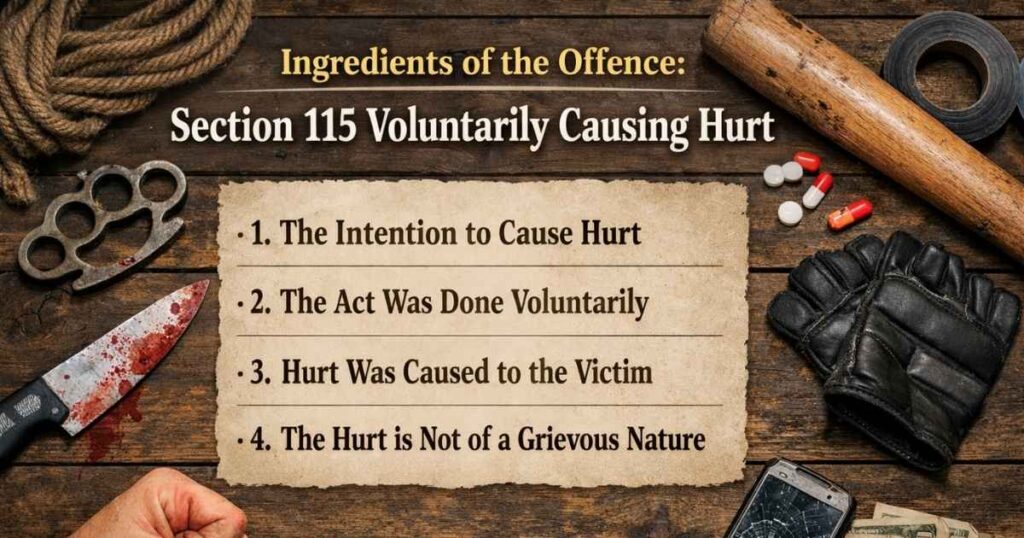
For a court to convict someone under Section 115, two core elements must be present. First, the accused must have either intended to cause hurt or had knowledge that their act was likely to cause hurt. Second, the act must have actually caused hurt meaning real bodily pain, disease, or infirmity to another person. Both ingredients must co-exist. If someone accidentally trips and injures another person, that isn’t voluntarily causing hurt there’s no knowledge of probable harm and no intention to cause harm.
Punishment for Section 115 Voluntarily Causing Hurt
The punishment under Section 115(2) is clear: imprisonment for a term up to one year, or a fine up to ₹10,000, or both. This applies to the standard case of voluntary hurt where no exception under Section 122 applies. Courts have discretion in deciding whether to impose imprisonment, a fine, or both depending on the severity of the act, the nature of injury, and the circumstances involved.
It’s worth noting that this section deals with simple hurt, not grievous hurt. For more serious injuries, other provisions of the BNS apply with heavier penalties. Section 115 essentially handles everyday instances of physical assault under law slaps, punches, minor injuries caused knowingly, and similar acts.
Illustrations of BNS Section 115 Voluntarily Causing Hurt
Real-life examples make legal provisions much easier to understand. Here are eight illustrations that show how Section 115 applies in practice.
1. Intentional Physical Harm
A and B get into a heated argument over a parking spot. Furious, A punches B in the face, leaving a black eye and visible swelling. A clearly intended to cause hurt it wasn’t accidental and it wasn’t reflexive. This is a textbook case of intentional physical harm under Section 115(1). The intention was direct, the act was deliberate, and the result was bodily injury. A is liable under this section.
2. Knowledge of Likely Harm
C knows that D has a severe peanut allergy. During an argument, C deliberately serves D food containing peanuts, fully aware of the allergy. D suffers a dangerous allergic reaction. C may not have wanted D to suffer exactly that reaction, but they acted with clear knowledge of likely injury. That’s enough for liability under Section 115(1). Knowledge of probable harm is just as serious as direct intent in the eyes of the law.
3. Hurt in Self-Defense
E is being physically attacked by F. To stop the attack, E strikes F on the arm with a stick, causing a minor injury. E’s goal wasn’t to harm F it was to protect themselves. However, since E voluntarily performed an act that caused hurt, Section 115(1) technically applies. That said, E may successfully invoke self-defense provisions under BNS, which can serve as a complete or partial defense. The outcome depends on whether the force used was proportionate and necessary.
4. Throwing an Object with Knowledge
G and H are in a dispute. G picks up a stone and throws it at H. G’s aim isn’t perfect, but they knew the stone could hit H. It does striking H on the shoulder and causing pain and bruising. G acted with knowledge of likely harm, and that harm occurred. This falls squarely under voluntarily causing hurt as per Section 115(1). Even imperfect aim doesn’t remove legal liability when intent or knowledge exists.
6. Accidental but Known Risk of Harm
K lights firecrackers near a crowd at a public event, knowing full well that sparks could injure bystanders. One firecracker hits L, burning their hand. K didn’t mean to hurt L specifically but acted with knowledge that their actions posed a real risk of injury. Since hurt actually resulted, K is liable under Section 115(1). This illustrates how legal liability for hurt doesn’t always require a specific target general knowledge of risk is enough.
5. Intended Harm in a Group
I is part of a street protest that turns violent. I picks up a glass bottle and deliberately throws it at J, hitting them on the head and causing a cut that needs medical attention. The act was intentional I chose a target and threw with force. Group protest assault situations don’t dilute individual criminal liability. I is fully liable under Section 115(1) for voluntarily causing hurt.
7. Provoked Attack (Related to Section 122)
M publicly insults N in front of a crowd in a humiliating way. Enraged, N slaps M across the face, causing a bruise. N acted voluntarily, and M was hurt so Section 115 applies on the surface. However, the circumstances suggest this could qualify as a case of grave and sudden provocation under Section 122(1). If the court agrees, N’s punishment would be much lighter than the standard one-year term. This is how the exception section 122 operates in reality.
8. Throwing a Hot Drink
O and P are in a bitter argument. O, in a rage, throws a cup of hot tea at P, knowing it will burn them. The hot liquid spills on P’s arm, causing burns. O acted with knowledge of likely harm hot liquid on skin causes injury, and O knew that. The act resulted in actual bodily pain. This is a clear illustration of causing bodily pain through a voluntary act, and O faces liability under Section 115(1). The hot drink injury law case is a common illustration used in legal education.
Comparison with IPC Section 321 and IPC 323
| Feature | IPC Section 321/323 | BNS Section 115 |
| Definition of offence | Intention or knowledge of hurt | Same intention or knowledge |
| Maximum imprisonment | 1 year | 1 year |
| Maximum fine | ₹1,000 | ₹10,000 |
| Exception for provocation | Section 334 IPC | Section 122(1) BNS |
| Applies to | Simple hurt | Simple hurt |
The comparison with IPC Section 321 and IPC 323 shows that BNS didn’t reinvent the wheel it refined it. The core definition of voluntarily causing hurt remains the same. The key upgrade is the tenfold increase in the maximum fine, from ₹1,000 under IPC 323 to ₹10,000 under BNS Section 115(2). This signals that the legislature wants courts to have stronger financial deterrents at their disposal. Everything else the imprisonment cap, the basic definition, the provocation exception follows the same spirit as the old law.
Summary
Section 115 of the BNS punishes any act of voluntary hurt whether driven by clear intention or knowledge of likely harm. It retains the one-year imprisonment cap from IPC 323 but raises the fine to ₹10,000, reflecting a stricter approach to bodily injury offences. The exception under Section 122(1) for grave and sudden provocation provides a safety valve for cases where emotions genuinely overwhelmed judgment. For anyone studying BNS criminal law, Section 115 is a foundational provision that connects intent, knowledge, and consequence in a direct, accessible way.
FAQs
What is Section 115 of the Bharatiya Nyaya Sanhita?
Section 115 BNS defines and punishes the act of voluntarily causing hurt any act done with intention or knowledge of likely harm that actually results in bodily injury to another person.
What is the punishment under Section 115(2) BNS?
The punishment is imprisonment up to one year, a fine up to ₹10,000, or both, depending on the court’s discretion.
Is accidental harm covered under Section 115 BNS?
No. Section 115 requires intention or knowledge of likely harm. Purely accidental acts without any knowledge of risk don’t qualify under this section.
What is the exception under Section 122(1) BNS?
If hurt is caused under grave and sudden provocation directed only at the person who provoked the punishment reduces to up to one month’s imprisonment or a fine up to ₹5,000, or both.
How does BNS Section 115 differ from IPC Section 323?
Both carry the same maximum imprisonment of one year. The major difference is the fine IPC 323 capped it at ₹1,000, while BNS Section 115 raises it to ₹10,000.
Conclusion
Section 115 Voluntarily Causing Hurt of the Bharatiya Nyaya Sanhita (BNS) is more than just a legal provision it’s a clear signal from the legislature that intentional harm won’t be taken lightly. By raising fines and maintaining imprisonment terms, the BNS strikes a firm but balanced tone. It punishes deliberate acts while leaving room for human fallibility through the provocation exception.
Whether you’re a law student, a legal professional, or simply someone curious about your rights, understanding this section gives you a clearer picture of how Indian law treats physical harm. The law expects people to be aware of the consequences of their actions and Section 115 ensures there are real consequences when that awareness is ignored.

Daniel Cross is a legal researcher and freelance writer specializing in civil rights, policy analysis, and contemporary legal trends. With a strong background in academic writing and practical case review, he focuses on making complex legal concepts accessible to everyday readers while promoting clarity, fairness, and informed public discourse.